
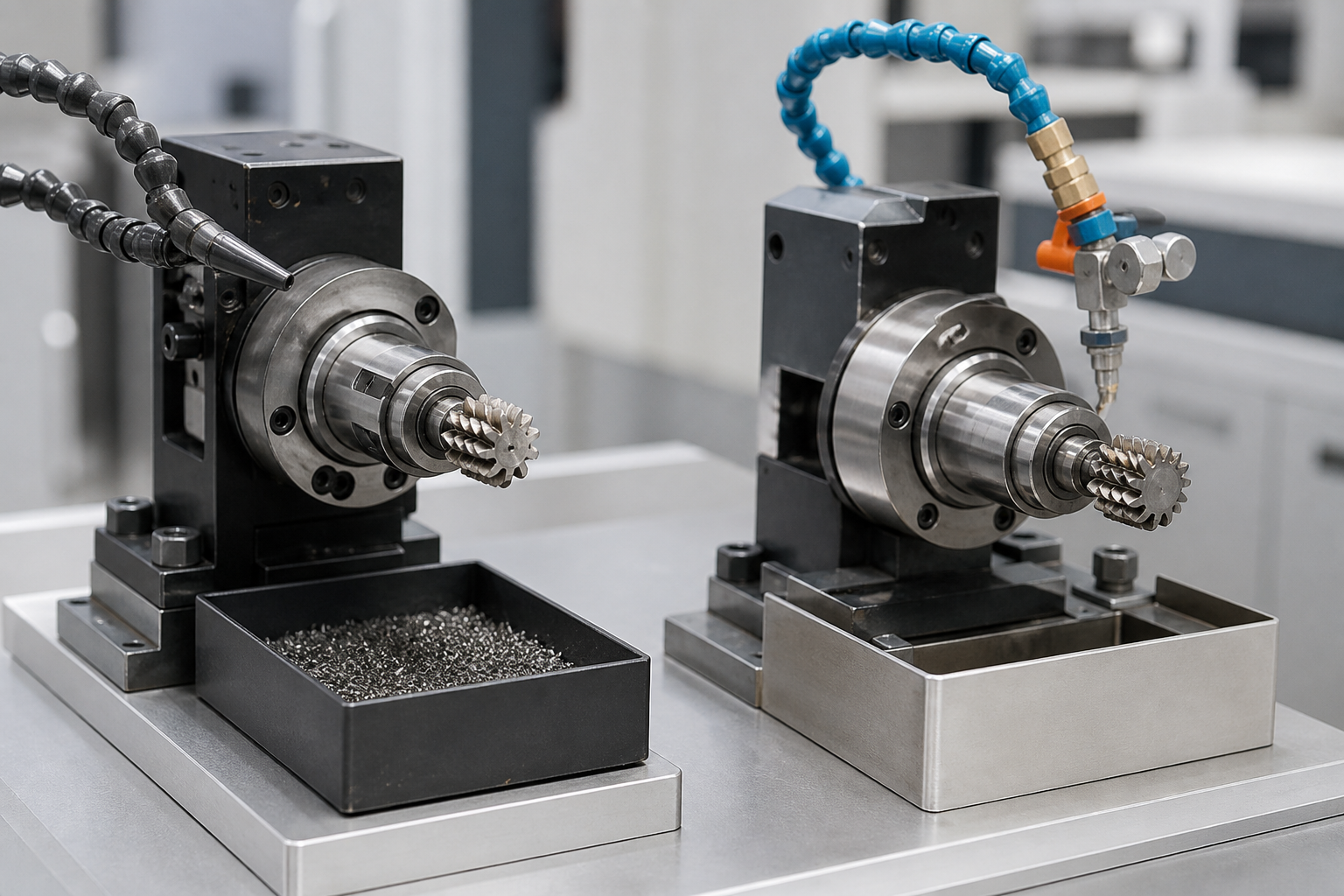
Dry vs Oil-Cooled Gear Hobbing: Choose a Hob from Verified Process Inputs
Cooling is not a detail to settle after a gear hob quotation arrives. It changes the documented operating environment for the tool family, so a shop planning dry cutting should not assume that an oil-cooled hob can simply be transferred to an air-cooled process.
For Nobeve’s carbide hob series, the published descriptions separate a K-Series high-speed dry-cutting option from G-Series and N-Series oil-cooled options. This checklist helps engineers and purchasing teams collect the right inputs for a technical review; it does not replace an application-specific recommendation.
The direct answer: establish the cooling method before selecting the series
The K-Series is documented for dry cutting with air cooling and for oil-cooled machining. The G-Series and N-Series are documented for oil-cooled machining environments. Cooling alone is not a complete selection rule: the workpiece hardness, machine speed, feed target and machine condition must also fit the stated series window.
| Question to confirm | K-Series | G-Series | N-Series |
|---|---|---|---|
| Documented cooling environment | Dry cutting with air cooling, or oil-cooled machining | Oil-cooled machining | Oil-cooled machining |
| Machine context stated in the series description | High-speed hobbing machines | High-speed hobbing machines | Traditional low-speed hobbing machines; also compatible with high-speed hobbing machines |
| Recommended workpiece hardness | At or below HRC 45 with EVO coating; HRC 35 to HRC 55 with AT coating | HRC 45 to HRC 62 | At or below HRC 30 |
| Recommended cutting speed | 150 to 300 m/min | 120 to 220 m/min | 60 to 150 m/min |
| Recommended feed | 0.5 to 0.8 mm/rev | 0.15 to 0.35 mm/rev | 0.3 to 0.8 mm/rev |
The values above are series-level published guidance, not a promise of part quality, tool life or output. Confirm the drawing, material condition and machine setup before releasing a tool specification.
1. Record what the cooling system can actually deliver
Start with the planned cutting environment: dry with air cooling, or oil-cooled. For a dry process, the published K-Series description is the relevant starting point. If the process requires oil cooling, K-, G- and N-Series may be discussed only after the other documented inputs are checked.
Do not substitute a different coolant strategy without engineering confirmation. The source does not establish MQL, water-based coolant or dry operation for G- or N-Series, so those conditions are needs verification.
2. Match hardness and coating to the documented window
Send the measured workpiece hardness, hardness scale and material condition—not just the material name. The K-Series description distinguishes its recommended hardness range by coating: at or below HRC 45 with EVO coating, and HRC 35 to HRC 55 with AT coating. The G-Series is documented for HRC 45 to HRC 62, while the N-Series is documented for workpieces at or below HRC 30.
For G-Series workpieces between HRC 56 and HRC 62, the series description recommends a secondary finish-hobbing pass. That is a documented condition to review, not a universal rule for every gear drawing or machine.
3. Check the machine against the intended cutting range
The series descriptions list K- and G-Series for high-speed hobbing machines. The N-Series is listed for traditional low-speed hobbing machines and is also described as compatible with high-speed hobbing machines. Compare the planned speed and feed with the relevant published range rather than copying a parameter from another tool family.
For example, a proposed dry process outside the K-Series range of 150 to 300 m/min, or an oil-cooled process outside the stated G- or N-Series windows, should be submitted for engineering review. Machine condition matters too: include spindle condition, arbor and mounting details, observed vibration, and any stability limitation.
4. Build an inquiry that can be reviewed without assumptions
Include these items with the gear drawing:
- Cooling method at the cut and any limits on air or oil delivery.
- Workpiece material, measured hardness and heat-treatment condition.
- Machine make/type, usable speed range, spindle and arbor condition, and any vibration history.
- Planned cutting speed and feed, or the production target that drives them.
- Gear geometry: module or diametral pitch, pressure angle, helix, tooth form and relevant clearances.
- Required gear quality, inspection method and production quantity.
This is also a useful point to capture the actual bottleneck. Is the constraint coolant availability, a legacy machine, hard material, cycle time, chip control or a quality requirement? Identifying it prevents a cooling choice from being treated as the only selection input.
When to request a technical review
Pause for an engineering review if cooling does not match the documented series environment, hardness is outside the listed range, the coating is not confirmed for K-Series, proposed parameters are outside the published range, or the machine condition and gear drawing are incomplete. These are selection questions, not safe assumptions.
For a process-level comparison, see Nobeve’s gear hobbing vs. power skiving guide. When your team has the drawing and checklist inputs, send them through the Nobeve contact page for an application-specific review. For an HSS hob request, provide the HSS tool specification and sourcing requirements separately; this K/G/N comparison covers the documented carbide hob families only.