
Why Gear Hob Wear Is Costing You More Than You Think
You pull the hob off the machine, hold it under the shop light, and see it again — that dull, abraded flank face, maybe a chipped tooth. You've been here before. Another tool change, another 20-minute interruption, another conversation with the purchasing team about cost per part.
Gear hob wear patterns aren't random. Flank wear, crater wear, and edge chipping each tell a specific story about what's going wrong in your process — and more importantly, what can be fixed. Engineers who understand these patterns can extend tool life by 2× to 5× simply by matching the right carbide grade and coating to their cutting conditions.
In this guide, we'll break down the three most common gear hob wear patterns, explain their root causes, and show you exactly how to counter each one. Whether you're running a high-speed dry-cut carbide hob or a PM-HSS power skiving cutter, the same diagnostic logic applies. By the end, you'll have a clear framework to prevent hob chipping and increase hob tool life — permanently.
| ** Key takeaway **: Identifying the wear type is the first step. Matching the right carbide grade and coating is the solution. |
The Three Primary Gear Hob Wear Patterns — Illustrated
Before choosing a solution, you need to identify the problem. Here are the five main wear patterns you'll encounter, with their visual signatures and root causes.
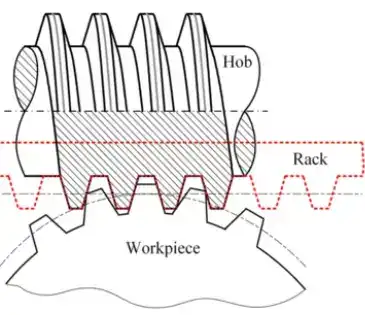
Below is a quick reference summary of all five wear types before we dive deep:
| Wear Type | Location | Primary Cause | Affected Tools |
| Flank Wear | Tool flank face | Abrasion from workpiece | All hob types |
| Crater Wear | Rake/chip face | High temp + chemical diffusion | Carbide hobs (dry cut) |
| Chipping | Cutting edge | Vibration / interrupted cut | Carbide hobs on old machines |
| Notch Wear | Depth-of-cut line | Work-hardened layer on edge | HSS/PM-HSS hobs |
| Built-Up Edge | Cutting edge | Low-speed adhesion of material | HSS (low Vc, no coating) |
1. Flank Wear — The Baseline Wear You'll Always See
What it looks like: A smooth, shiny worn land (VB) running along the flank face of the cutting edge, parallel to the machined surface.
Root cause: Abrasive contact between the tool flank and the freshly cut gear tooth surface. This is the most predictable, gradual wear mode — the gear cutting equivalent of sandpaper slowly removing material from your tool.
When it becomes a problem: Once VB exceeds ~0.3 mm for finishing hobs, surface finish deteriorates and dimensional accuracy drifts out of DIN tolerance. For carbide hobs running at 150–300 m/min, flank wear progresses slowly if the coating is intact. For PM-HSS tools running at 60–150 m/min, wear is faster on harder materials.
How to counter it: Flank wear responds directly to coating hardness. Hobs equipped with BALINIT® ALCRONA PRO (AlCrN-based) coatings show significantly lower wear rates versus uncoated tools. For very abrasive workpieces, specifying a finer WC grain carbide substrate (sub-micron grade) dramatically improves resistance.
The K-Series High-Speed Dry Cutting Hobs from Nobeve are built specifically to minimize flank wear in high-volume automotive gear production, using Konrad Friedrichs solid carbide bar stock with BALINIT® ALCRONA PRO or ALTENSA coatings rated for cutting speeds up to 300 m/min.
2. Crater Wear — The Silent Threat in High-Speed Carbide Cutting
What it looks like: A concave depression (crater) forming on the rake face of the tooth, typically 0.1–0.5 mm behind the cutting edge.
Root cause: Thermo-chemical diffusion. At cutting temperatures above 700–900°C — common in dry carbide hobbing — tungsten and cobalt atoms literally diffuse from the tool into the chip. This softens the substrate beneath the coating and creates a crater that progressively weakens the edge geometry.
When it becomes a problem: When the crater reaches the cutting edge, it causes sudden edge failure. This is why you sometimes find a hob that "ran fine" suddenly chips catastrophically: the crater had been quietly deepening for the last 10 production runs.
How to counter it: Crater wear is fundamentally a thermal problem. Two solutions work in tandem:
- Upgrade the coating: BALINIT® ALTENSA (TiAlSiN-based) forms a thermally stable alumina layer above 700°C, acting as a thermal barrier between the chip and the substrate. This is the coating specified on Nobeve's G-Series and W-Series tools for hard-cutting applications.
- Optimize the cutting speed: If you're running above the recommended Vc for your specific material, reduce speed by 10–15%. A modest drop in speed can halve crater wear rates.
For hard gear cutting (HRC 45°–62°), the G-Series High-Speed Hard Cutting Hobs are engineered with ALTENSA coating specifically to resist crater formation at elevated temperatures. Gear engineers working in this hardness range should treat crater wear monitoring — via periodic SEM inspection or even portable USB microscope — as standard practice.
3. Edge Chipping — The Wear Pattern That Destroys a Hob Overnight
What it looks like: Irregular, jagged micro-fractures along the cutting edge, ranging from hairline cracks to visible tooth breakage.
Root cause: Mechanical shock. Carbide, for all its hardness, is brittle. Vibration from an insufficiently rigid machine spindle, interrupted cuts, or even slight hob runout can send a stress pulse through the edge that exceeds the material's fracture toughness — and the edge chips.
This is why machine rigidity is non-negotiable for carbide hobs. As Nobeve's own W-Series documentation states explicitly: "Carbide power skiving cutters have high rigidity requirements for the machine spindle — vibration easily causes chipping." This is not a minor caveat. It is the central design constraint for carbide tool selection.
How to counter it: The fix depends on the root cause:
- Vibration source: Check spindle runout (target < 3 μm), verify hob arbor torque, and inspect the machine foundation. A hob running at 0.01 mm runout will chip 10× faster than one at 0.003 mm.
- Interrupted cuts / difficult materials: Switch from carbide to PM-HSS for high-toughness materials or legacy machines. The P-Series PM-HSS Power Skiving Tools use a tapered (conical) body design that significantly reduces chipping risk on tough, low-HRC materials.
- Substrate grade: If chipping persists on a rigid machine, consider specifying a tougher carbide grade with slightly lower hardness — trading some wear resistance for fracture toughness.
For shops running older equipment or mixed material batches, the N-Series Low-Speed Soft Cutting Hobs and P-Series PM-HSS Power Skiving Tools are specifically engineered to absorb vibration and resist chipping in exactly these conditions.
How to Exponentially Extend Tool Life: Carbide Grade + Coating Strategy
Here's the honest truth that many tool vendors won't say directly: the same wear pattern can require completely different solutions depending on your process conditions. Flank wear in dry cutting is a coating problem. Flank wear in oil-cooled cutting at low speed is a substrate hardness problem. Crater wear at 250 m/min is a thermal coating problem. Crater wear at 80 m/min is a cutting speed problem.
The key is to treat carbide grade and coating as a system — and to choose that system based on your specific wear mechanism.

Carbide Grade Selection: Hardness vs. Toughness Trade-off
Tungsten carbide (WC+Co) grades exist on a spectrum. More cobalt = more toughness, less hardness. Less cobalt = more hardness, more brittleness. For gear hob applications:
- Fine-grain, low-Co grades (e.g., 6% Co): Best for high-speed finishing hobs (K-Series, G-Series). Maximum hardness for abrasive resistance, but demands rigid machine setup.
- Medium-grain, medium-Co grades (e.g., 8–10% Co): Balanced choice for W-Series power skiving tools. Provides good hardness with enough toughness for the interrupted-cut nature of skiving.
- Sintered/pressure-cast grades (N-Series): Conventional WC-Co grades optimized for wet cutting at lower speeds, prioritizing toughness and cost-efficiency for job shops.
Nobeve's K-Series and G-Series hobs use solid carbide bar stock imported from Konrad Friedrichs (Germany) — a substrate specification chosen specifically for its grain uniformity, which directly translates to consistent coating adhesion and predictable tool life. The W-Series Solid Carbide Power Skiving Tools use a cold-forged WC-Co grade that provides enhanced strength versus conventional sintered grades.
Coating Selection: Matching the Thermal Profile of Your Cut
Coatings operate within specific thermal windows. Selecting the wrong coating for your temperature regime is one of the most common — and most fixable — causes of premature hob failure.
- BALINIT® ALCRONA PRO (AlCrN): Oxidation resistance up to ~1100°C. Ideal for K-Series dry hobbing, general-purpose carbide hobs on steels up to HRC 45°. The AlCrN chemistry provides excellent lubricity, reducing friction and heat generation at the cutting edge.
- BALINIT® ALTENSA (TiAlSiN): Superior performance in hard-cutting above HRC 45°. The SiN component creates an extremely hard, thermally stable layer that resists crater formation even under the aggressive thermal loads of dry hard skiving at 120–300 m/min. Standard on G-Series, W-Series, and P-Series Nobeve tools.
The decision to use Balzers coatings on every Nobeve product line — including the HSS-based N-Series and P-Series — reflects a deliberate quality philosophy: even a tougher, slower-cutting substrate benefits enormously from a high-performance coating. A PM-HSS hob with ALTENSA will consistently outlast an uncoated or TiN-coated PM-HSS hob by 3× or more in practical production testing. For more technical reading on gear cutting tool materials, the Gear Technology magazine technical library provides peer-reviewed research on coating performance in hobbing applications.
Quick Selection Guide: Which Nobeve Hob Series Addresses Your Wear Problem?
Use this table to match your production environment to the right Nobeve hob series. The goal is to eliminate the root cause of wear, not just replace tools faster.
| Your Machine | Material HRC | Recommended Series | Key Benefit |
| High-speed CNC (rigid) | ≤ 45° | K-Series Carbide Hobs | Dry cut, 300 m/min, max throughput |
| High-speed CNC (rigid) | 45°–62° | G-Series Carbide Hobs | Hard-cutting up to HRC 62° |
| Legacy / older hobber | ≤ 30° | N-Series Carbide Hobs | Vibration-tolerant, low cost |
| Power skiving machine | ≤ 30° | P-Series PM-HSS Skiving | Anti-chipping, tough materials |
| Power skiving machine | ≤ 50° | W-Series Carbide Skiving | High speed, internal gears |
Can't find your exact scenario? Contact Nobeve's engineering team directly. Send your DXF, DWG, or STEP drawings and our engineers will specify the optimal substrate, coating, and geometry for your specific workpiece and machine combination — at no charge.
Practical Wear Diagnostic Checklist — Use This Before Ordering
When a hob fails prematurely, work through this checklist before assuming the tool is at fault. In our experience, more than 60% of "tool quality" complaints trace back to one of these process variables:
- Inspect the wear location first: Flank only? Classic abrasion — coating upgrade or speed reduction. Rake face crater? Thermal issue — check cutting speed and switch to ALTENSA. Random chipping? Machine vibration or runout — measure spindle before changing anything else.
- Check your cutting parameters: Are you within the recommended Vc and feed range for your hob series? Running a K-Series at 60 m/min can cause built-up edge and adhesive wear — the opposite of its design intent.
- Verify machine spindle runout: For carbide hobs, target < 3 μm. Above 5 μm, edge chipping risk increases dramatically regardless of tool quality.
- Confirm coolant delivery (if oil-cooled): For G-Series, N-Series, and P-Series, inadequate oil pressure (target > 40 bar) allows thermal shock at the cutting edge, accelerating both flank wear and chipping.
- Review your regrinding intervals: Letting a hob run beyond its VB limit causes accelerated wear in subsequent shifts. Establish a fixed regrind interval based on flank wear measurement, not on "it still looks okay."
Frequently Asked Questions (FAQ)
Q1: What is the acceptable flank wear limit (VB) for a gear finishing hob?
For precision finishing applications (DIN AA / DIN AAA grade), the practical regrind threshold is VB = 0.2–0.3 mm on the tool flank. Exceeding this level causes measurable deterioration in tooth surface finish (Ra) and involute accuracy. For roughing passes, some shops run to VB = 0.4–0.5 mm, but this increases the risk of work-hardening the gear tooth surface, which then accelerates wear on the next tool.
Q2: Can I use a carbide hob on my older (pre-2010) gear hobber?
It depends on spindle runout and maximum RPM, but generally: proceed with caution. Older hobbers often have higher spindle runout (>5 μm) and less rigid arbor systems, which creates the exact vibration conditions that cause carbide edge chipping. For these machines, the N-Series Low-Speed Carbide Hobs are specifically engineered for this environment — a sintered WC-Co grade that prioritizes toughness over hardness, paired with ALCRONA PRO coating for maximum value.
Q3: How do I know if chipping is from vibration or from a carbide grade mismatch?
Vibration-induced chipping typically produces irregular, "tearing" fractures distributed randomly across teeth — especially at the tooth corners. Grade-mismatch chipping (too brittle for the interrupted cut) tends to produce more uniform micro-fractures along the entire cutting edge. If you can measure spindle runout and confirm it's within spec but chipping persists, request a tougher carbide grade variant from your hob supplier.
Q4: Does coating thickness affect gear tooth accuracy?
Yes, and it's often underestimated. Standard PVD coatings like BALINIT® ALCRONA PRO add approximately 2–4 μm per surface. For DIN AA precision hobs, this is accounted for in the grinding cycle post-coating. At Nobeve, all precision hobs undergo final grinding after coating application to ensure the tooth profile dimensions remain within DIN specification, with coating present only on the relief faces — not on the tooth profile itself.
Q5: How much tool life improvement can I realistically expect from upgrading coatings?
In controlled production testing on steel gears (18CrNiMo7-6, module 3, Vc = 180 m/min), switching from TiN to BALINIT® ALTENSA typically shows a 2.5× to 4× increase in hob life before regrind. In dry hard-cutting applications (HRC 55°+), the difference can be even larger — TiN coatings may fail within 3–5 minutes of cutting, while ALTENSA reaches 30+ minutes under the same conditions.
Q6: What's the minimum investment to properly diagnose wear patterns?
You don't need expensive SEM equipment to get started. A 40× USB digital microscope (~$30–50) can clearly resolve flank wear bands, crater formation, and chipping. For more precise VB measurement, optical comparators or tool-maker microscopes provide 1 μm resolution. The real investment is in developing a consistent inspection routine — measuring every regrinded hob before reinstallation and tracking wear progression over multiple cuts.
Conclusion: Stop Replacing Hobs — Start Understanding Them
Gear hob wear patterns are not random events. Flank wear tells you about abrasion and coating hardness. Crater wear tells you about thermal loads and the cutting speed regime. Chipping tells you about machine rigidity and substrate toughness. Each pattern has a specific cause, and each cause has a specific fix.
The engineers and purchasing professionals who consistently achieve the lowest cost-per-part don't just order hobs — they specify them. They know their spindle runout, they know their workpiece hardness, and they understand that choosing between K-Series dry carbide, G-Series hard-cutting, or P-Series PM-HSS skiving tools is an engineering decision, not a purchasing decision. Visit https://nobeve-tool.com/ to explore the full product range, technical specifications, and application data sheets for all Nobeve gear cutting tool series.
| ** Get a Free Engineering Evaluation ** Send your DXF, DWG, or STEP drawings to Nobeve's engineering team for a no-cost, no-obligation tool specification review. We'll analyze your gear parameters, workpiece material, and machine conditions — and recommend the optimal hob series, carbide grade, and coating for your application. ** Email drawings to: nobeve.tool@gmail.com | ** nobeve-tool.com/contact-us/ |