
Selecting the wrong gear cutting tool is one of the most expensive mistakes in gear manufacturing. A tool that's undersized for your material hardness will fail prematurely. One that's over-specified for your production volume will drain your budget unnecessarily.
This guide walks you through the five key factors that determine the right gear tool for your application: cutting method, material, module range, coating, and production volume. By the end, you'll know exactly what questions to ask - and what answers to expect from your tool supplier.
Nobeve's gear tool portfolio covers the full spectrum from entry-level soft cutting to high-speed hard finishing. Let's find the right fit for your production floor.
Step 1: Match the Cutting Method to Your Gear Geometry
Before diving into specifications, you need to answer one fundamental question: can this gear be produced by hobbing, or does it require skiving?
- Hobbing is the right choice for: external spur gears, helical gears, sprockets, worms, and internal gears with sufficient axial clearance
- Skiving is essential for: internal gears with blind bores, cluster gears, gears with restricted access, and applications where hobbing cycle times are prohibitively long
If you're producing automotive transmission gears, there's a strong chance that power skiving with Nobeve's W-Series or P-Series skiving tools will offer the best economics. For industrial machinery, heavy equipment, and wind energy applications, gear hobs in the K/G/N series remain the standard.
The Internal Gear Challenge
Internal gears represent one of the clearest cases for tool selection. If the gear has a bore diameter smaller than what a hob can enter - or if the gear is positioned close to a shoulder that blocks hobbing access - power skiving is not just preferable, it's the only viable option. Nobeve's W-Series solid carbide skiving cutters are specifically engineered for this scenario, operating at cutting speeds of 120-300 m/min.
Step 2: Match Tool Material to Your Workpiece Hardness
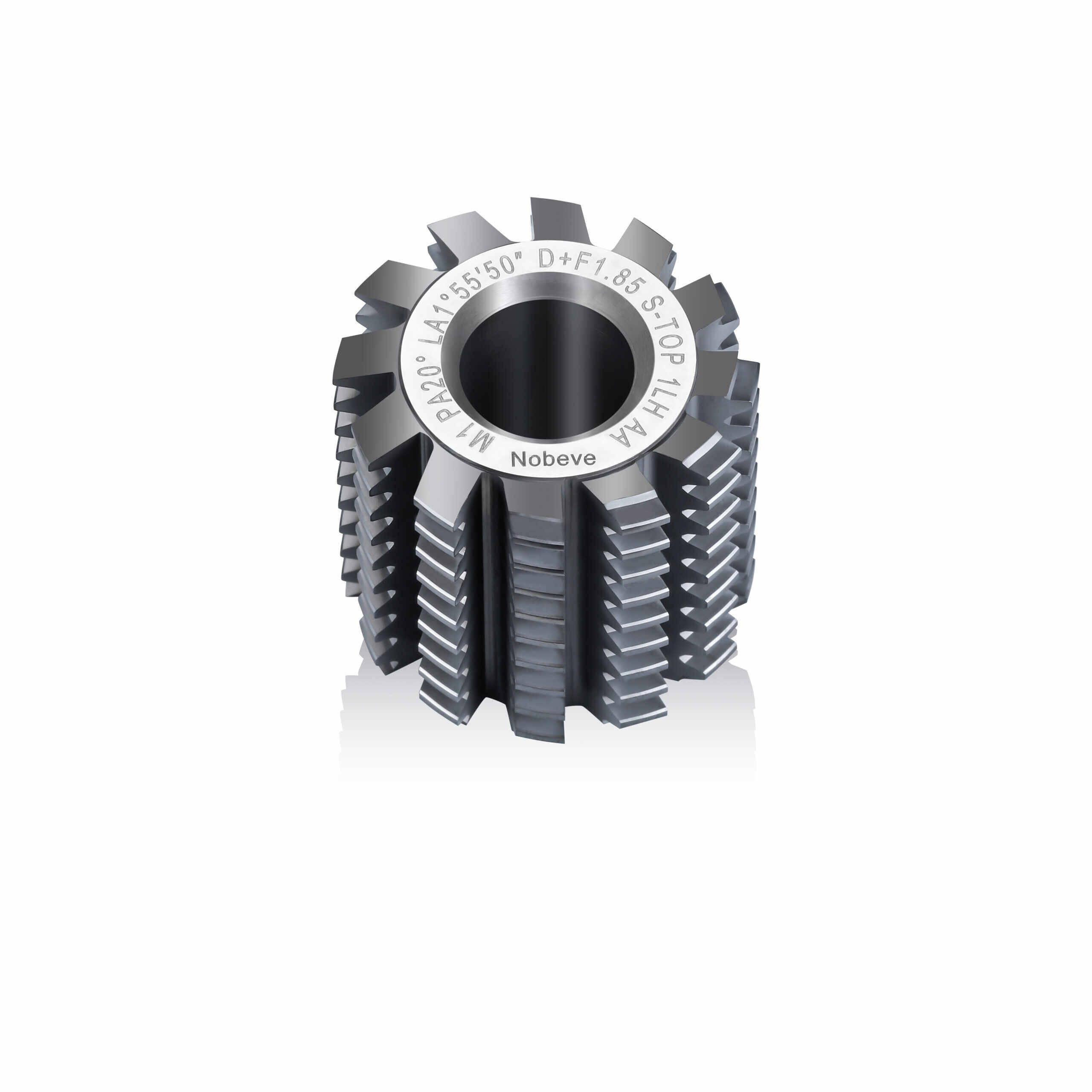
Your workpiece material hardness is the single most important driver of tool selection. Here's a practical framework:
| Workpiece Condition | Hardness Range | Recommended Tool | Nobeve Series |
|---|---|---|---|
| Soft cutting (annealed/normalized) | HB <= 200 (HRC <= 30) | PM HSS or carbide | N-Series or P-Series |
| Pre-hardened steel | HRC 30-45 | Uncoated or PVD-coated carbide | K-Series |
| Hardened steel (finish cutting) | HRC 45-62 | PVD-coated carbide (BALINIT ALCRONA PRO) | G-Series |
| High-speed dry cutting | HRC <= 45 | Specialized dry-cut geometry | K-Series (dry configuration) |
For hard gear cutting (HRC 45-62), Nobeve's G-Series high-speed hard-cutting hobs with BALINIT ALCRONA PRO coating from Balzers represent the current state of the art. The coating's excellent hot hardness and oxidation resistance enable cutting speeds of 120-220 m/min in the hard gear cutting range.
For high-volume soft cutting where cycle time is critical, the Nobeve K-Series operating at 150-300 m/min under MQL (Minimum Quantity Lubrication) conditions delivers outstanding productivity while eliminating coolant costs.
Step 3: Define Your Module Range and Production Quantity
Module (the gear tooth size metric) directly impacts tool selection:
- Fine module (0.5-2.0 mm): Requires precision-ground tools with tight tolerances. Carbide is preferred for rigidity at small diameters. Nobeve's miniature gear hobs and fine-pitch skiving cutters handle this range with excellent results.
- Medium module (2.0-8.0 mm): The most common range for automotive and industrial transmission gears. This is the sweet spot for both hobbing and skiving. K-Series and G-Series hobs excel here.
- Large module (8.0-25+ mm): Typically produced by N-Series low-speed soft-cutting hobs in PM HSS. The slower cutting speeds (60-150 m/min) reduce thermal shock and enable long tool life in large-scale gear production.
Production quantity also matters: for very high volumes (100,000+ pieces/year), investing in precision-ground carbide tools pays off faster through reduced tool changes and more consistent quality. For smaller batches, PM HSS tools with longer life between grinds may offer better value.
Step 4: Choose the Right Coating for Your Process Conditions

Coating technology has a direct, measurable impact on tool performance. The two most relevant coatings for gear cutting tools are:
BALINIT ALCRONA PRO (Balzers)
An advanced AlCrN-based PVD coating that delivers:
- Excellent hot hardness up to 1100 degC
- Superior oxidation resistance for dry cutting applications
- Low tendency for built-up edge (BUE) formation
- Ideal for hard gear cutting and high-speed applications
This is the standard coating on Nobeve's G-Series hard-cutting hobs, providing the thermal stability needed for cutting hardened gears at elevated speeds.
BALINIT ALTENSA (Balzers)
An AlTiSi-based coating optimized for:
- High-temperature machining of soft and pre-hardened steels
- Applications where built-up edge resistance is critical
- MQL and dry cutting environments
Available on select Nobeve K-Series and N-Series hobs, BALINIT ALTENSA provides excellent performance in the temperature ranges typical of high-speed dry hobbing.
Step 5: Verify Cutting Parameters with Your Tool Supplier
Even the best tool selection can fail without proper cutting parameters. Before finalizing your choice, consult with your tool supplier on:
- Recommended cutting speeds (Vc): Based on tool material, coating, and workpiece hardness
- Feed per tooth (fz): Affects surface finish, chip load, and tool stress
- Axial feed rate: Determines cycle time and tool life balance
- Cooling strategy: Flood, MQL, or dry - each requires parameter adjustments
- Hob shift schedule: For maximizing tool life on high-volume jobs
Nobeve's technical support team provides cutting parameter recommendations and hob shift schedules as part of their standard technical service for customers worldwide.
Frequently Asked Questions
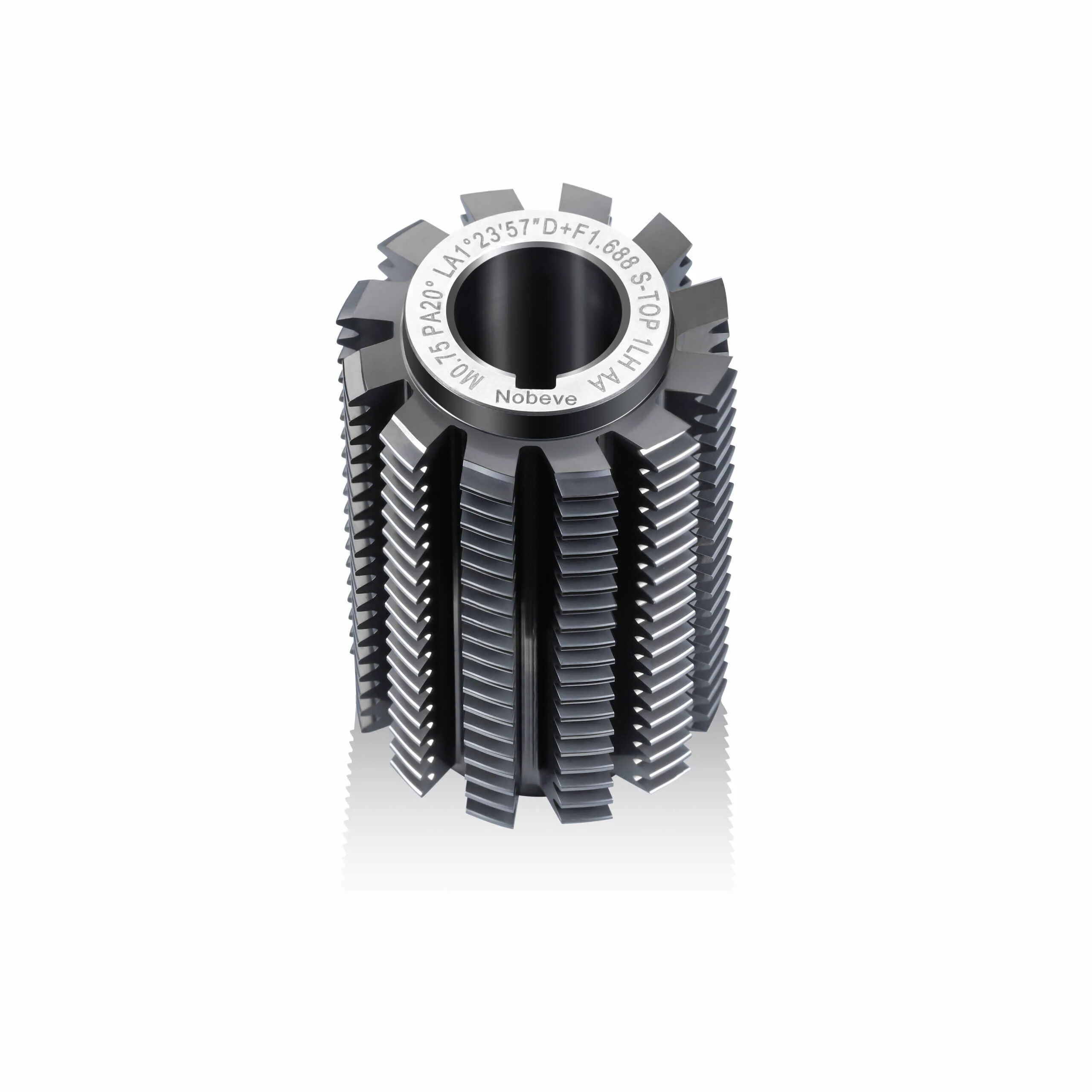
What's the difference between PM HSS and solid carbide for gear hobs?
Powder Metallurgy HSS (PM HSS) hobs offer excellent toughness and cost-effectiveness for medium-to-large module gears and lower-speed applications. Solid carbide hobs provide superior stiffness, higher cutting speeds, and longer tool life - but at significantly higher initial cost. The break-even point typically depends on your production volume and cutting speed requirements. For high-speed dry cutting (150-300 m/min), carbide is generally the better choice.
Can I use a hob designed for wet cutting in a dry or MQL environment?
Not recommended. Dry/MQL geometries have different chip gullet depths and optimized rake angles for effective chip evacuation without flood coolant. Using a wet-cut hob in dry conditions often leads to poor chip evacuation, built-up edge, and premature tool failure. Always specify the cutting environment when ordering gear tools.
How do I know when it's time to regrind my hob?
Common indicators include: increasing cutting forces (noticeable in machine load readings), degradation in gear surface finish, dimensional drift on finished gears, and accelerated flank wear. For production hobs with PVD coating, Nobeve recommends inspection every 500-1000 parts depending on the application. After regrinding, the coating can typically be reapplied, restoring the tool to near-original performance.
What is hob shifting and why does it matter?
Hob shifting is a technique where the hob is periodically moved axially to distribute wear across more of its cutting edges. Without shifting, only a portion of the hob's teeth do all the work, leading to localized wear and shorter tool life. A proper shift schedule - typically 1/4 to 1/2 of the hob's axial length per shift - can extend effective tool life by 3-5x. Nobeve provides shift schedule recommendations with all production hob orders.
Conclusion: Making the Right Choice Starts with Knowing Your Application
Gear tool selection isn't about finding the "best" tool - it's about finding the right tool for your specific combination of gear geometry, material, volume, and equipment. Use the five-step framework in this guide to narrow your options, then engage with your tool supplier to validate the selection with real cutting data.
Nobeve's product range - from N-Series soft-cutting hobs for large-module industrial gears to W-Series solid carbide skiving cutters for high-speed automotive production - covers virtually every mainstream gear manufacturing application.
Need help narrowing down your options? Get in touch with Nobeve's engineering team for a free technical consultation.