
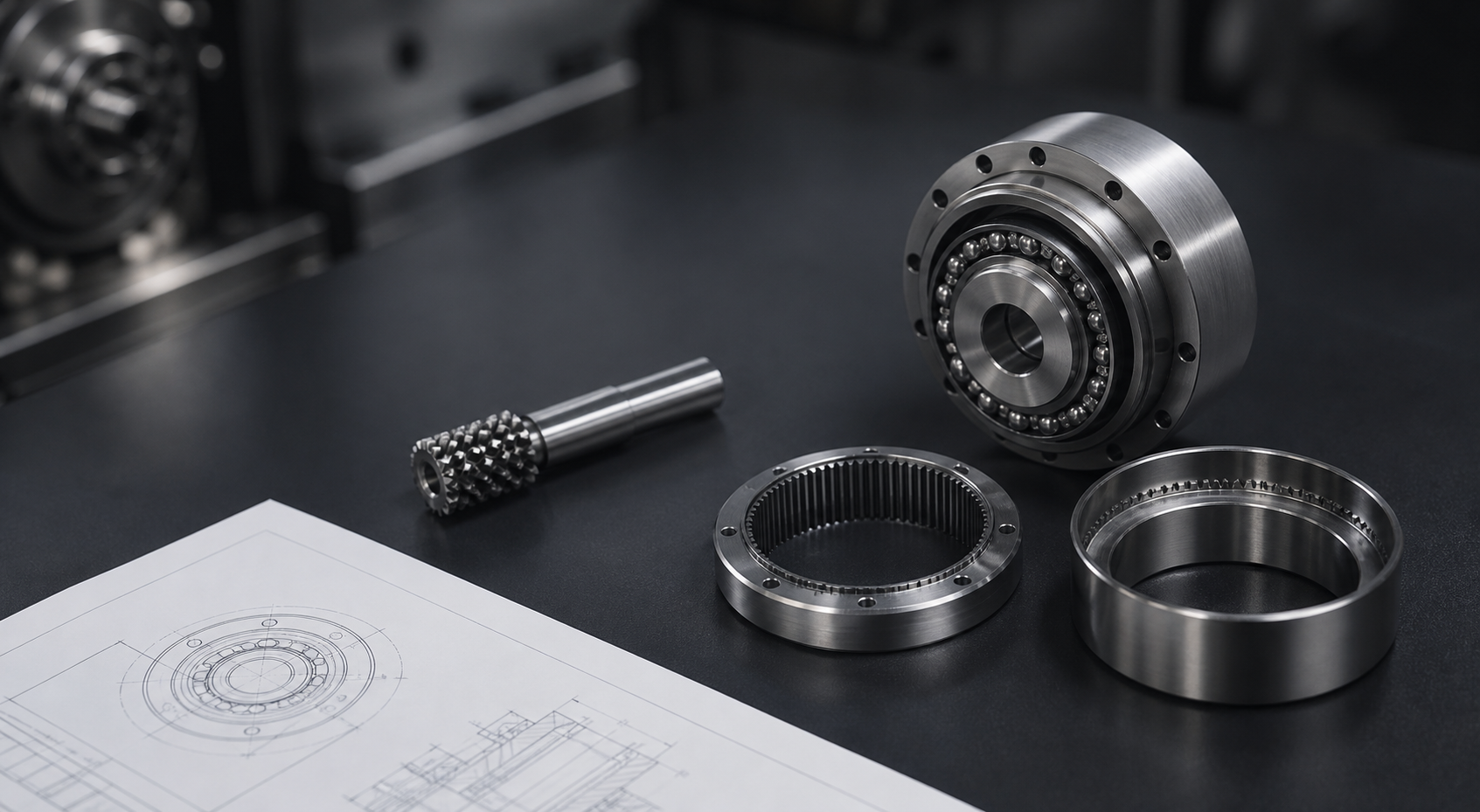
Harmonic Reducer Gear Cutting Tool Consultation: What to Prepare First
When a harmonic reducer project reaches the tooling stage, a request for “a gear cutting tool” is not yet enough to review the application. The useful first step is to send the component drawing, describe the intended operation, and identify the machine condition and the production bottleneck.
Nobeve’s catalogue includes harmonic reducer gears in its overview of component applications. That is a starting point for a consultation, not a promise of tool selection, process capability, cycle time, quality result or machine compatibility. Those decisions need review of the actual component and process information.
Start with the original component drawing
Send the current drawing and its revision, preferably in the original format available to your team. Retain the pitch notation and units shown by the design rather than substituting a rounded conversion.
Make the relevant component information easy to find:
- Module or diametral pitch as specified on the drawing.
- Pressure angle, tooth count and helix angle where applicable.
- Material, measured hardness value and hardness scale.
- The drawing’s stated quality or inspection requirement.
- Bore, shank, mounting, clearance or keyway details that affect the intended setup.
If an item is not known, mark it as open. An engineering review can then distinguish a missing input from a confirmed design value.
Describe the intended cutting operation
State which harmonic reducer component feature is in scope and what operation the requested tool is intended to support. Include the material condition at the operation, any heat-treatment position in the route, and downstream requirements that may affect the drawing interpretation.
This keeps a consultation tied to one defined feature and operation. It avoids turning a broad application reference into an unsupported recommendation for a particular gear form, cutter type or process route.
Include machine condition and the real bottleneck
Add the actual machine type, spindle or arbor interface, workholding arrangement, available speed range and cooling condition. If a process already exists, provide its known parameters and any relevant inspection or wear observations.
Then state the bottleneck in plain language. It may be an unclear drawing callout, a clearance concern, a setup-stability issue, an observed wear issue or a new-part launch. Describe what was observed and where; do not assign a root cause before it has been reviewed.
Keep each tool request within its own scope
One harmonic reducer programme can include different gear-cutting operations. Keep each request connected to the component feature, operation and machine that apply to it.
- For HSS hob sourcing, identify the request as HSS-hob sourcing and provide the hobbing specification and sourcing requirements.
- For a carbide hob inquiry, provide the hobbing machine and application information for that specific operation.
- For a carbide power-skiving tool, prepare a separate cutter-and-process package inquiry with its own machine, cooling and geometry context.
This separation gives the engineering review a clear scope rather than carrying one assumption across every operation in the programme.
Send a concise consultation package
Before requesting a quotation or a recommendation, combine these items in one package:
- The original component drawing, revision and any relevant mating or clearance information.
- The drawing values for geometry, material condition, hardness and stated quality requirement.
- The intended operation and its position in the process route.
- Machine, mounting, workholding and cooling details.
- The actual bottleneck, supporting records and any decision that needs engineering confirmation.
For broader drawing-preparation guidance, see the custom gear tool drawing checklist. When the package is ready, send it through the Nobeve contact page for an application-specific consultation before a tool recommendation or quotation is finalized.