
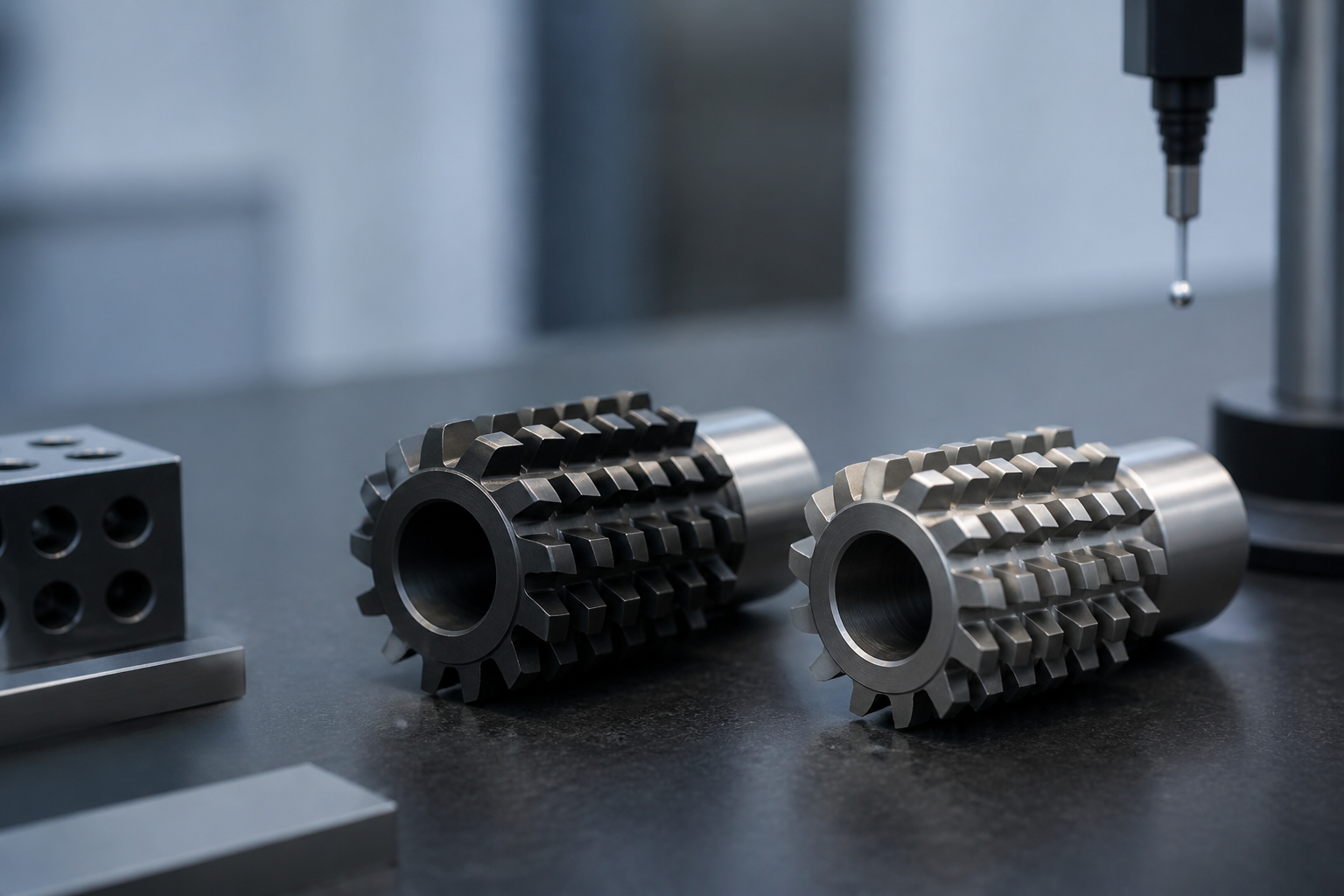
PM-HSS vs Carbide Power Skiving Tools: Choose from the Inputs That Matter
When a purchasing team needs a power skiving cutter, “PM-HSS or carbide?” can sound like a simple material choice. It is not. A cutter that looks suitable on paper can be a poor fit if the workpiece hardness, machine rigidity, oil-cooling capability, speed and feed targets have not been confirmed.
For Nobeve power skiving tools, the controlled series descriptions provide different documented operating windows for the P-Series PM-HSS and W-Series carbide families. Use the comparison below to prepare a technically reviewable inquiry—not to substitute for an application-specific tooling recommendation.
The short answer: match the documented series window first
Start with the workpiece hardness and machining environment. The P-Series PM-HSS tool is documented for oil-cooled wet cutting, workpieces at or below HRC 30, cutting speeds of 60–150 m/min and feeds of 0.2–0.4 mm/rev. The W-Series carbide tool is documented for oil-cooled cutting, workpieces at or below HRC 50, cutting speeds of 120–300 m/min and feeds of 0.2–0.5 mm/rev.
Both series are listed as DIN AA accuracy class. This is a series description, not a promise that every part, machine or setup will achieve a specified result. Confirm the part drawing, machine condition and process requirements with engineering before release.
| Input to confirm | P-Series PM-HSS | W-Series carbide |
|---|---|---|
| Documented base material | Solid round bars imported from BÖHLER (Austria) | Cold-forged and sintered tungsten-cobalt alloy |
| Documented coating | BALINIT® ALTENSA | BALINIT® ALTENSA |
| Recommended workpiece hardness | ≤ HRC 30 | ≤ HRC 50 |
| Recommended cutting speed | 60–150 m/min | 120–300 m/min |
| Recommended feed | 0.2–0.4 mm/rev | 0.2–0.5 mm/rev |
| Documented environment | Oil-cooled wet cutting | Oil-cooled |
| Accuracy class | DIN AA | DIN AA |
Decision path for a power skiving tool inquiry
1. Record material and hardness in its actual cutting condition
Do not select from a material name alone. Send the workpiece material, measured hardness value, hardness scale and condition. The P-Series description is limited to ≤ HRC 30; the W-Series description is limited to ≤ HRC 50. If the part is above either stated limit, or the hardness condition is not known, the selection is needs verification.
2. Confirm that oil cooling is available at the cut
Both documented series use oil-cooled machining. Include the cooling method and any practical delivery constraints in the request. The source does not establish dry, MQL or water-based operation for these two series, so those alternatives require engineering verification.
3. Compare the planned speed and feed with the documented window
The W-Series has the higher published speed range, while the P-Series range starts lower. That comparison is useful only after the machine’s usable speed, actual setup and intended process have been checked. A proposed speed or feed outside the published range is a review point, not a value to assume can be carried over from another tool family.
4. Treat spindle rigidity as a selection input, not an afterthought
Nobeve states that the W-Series has high requirements for spindle rigidity and that excessive vibration can readily cause tool chipping. The P-Series description notes the toughness advantage of a recommended conical design for soft or certain high-toughness materials, with a reduced probability of tooth chipping; it also notes relatively higher wear when cutting harder materials.
Document the machine type, spindle condition, workholding approach and any observed vibration or interrupted engagement. The P-Series is described as suitable for gear hobbing machines and turn-mill centers; the W-Series is described as compatible with gear turning machines and turn-mill centers. Compatibility still needs confirmation for the actual installation.
What to send for a reviewable choice
Prepare the following before asking for a quotation or tooling recommendation:
- Gear drawing and the required tooth geometry, module or diametral pitch, pressure angle, helix and relevant clearance constraints.
- Workpiece material, hardness value and the condition in which it was measured.
- Machine type, spindle details, cutter mounting and workholding information.
- Oil-cooling arrangement at the cutting zone.
- Current or planned cutting speed and feed.
- Required DIN or customer-specified accuracy requirement, plus the intended inspection method.
- Whether the operation involves soft or high-toughness material, vibration, or other conditions that should be evaluated for chipping risk.
When to pause and request engineering verification
Request an application review rather than forcing a series choice when the hardness is outside the documented range, cooling is not oil-based, planned parameters are outside the stated windows, spindle rigidity is uncertain, or the drawing and inspection requirement are incomplete. The same applies when a machine or process is not clearly covered by the listed compatibility statement.
For a broader explanation of the process and the questions to bring to a technical discussion, see Nobeve’s power skiving tool guide. When you have the inputs above, send them with the part drawing through the Nobeve contact page for an application-specific review.