
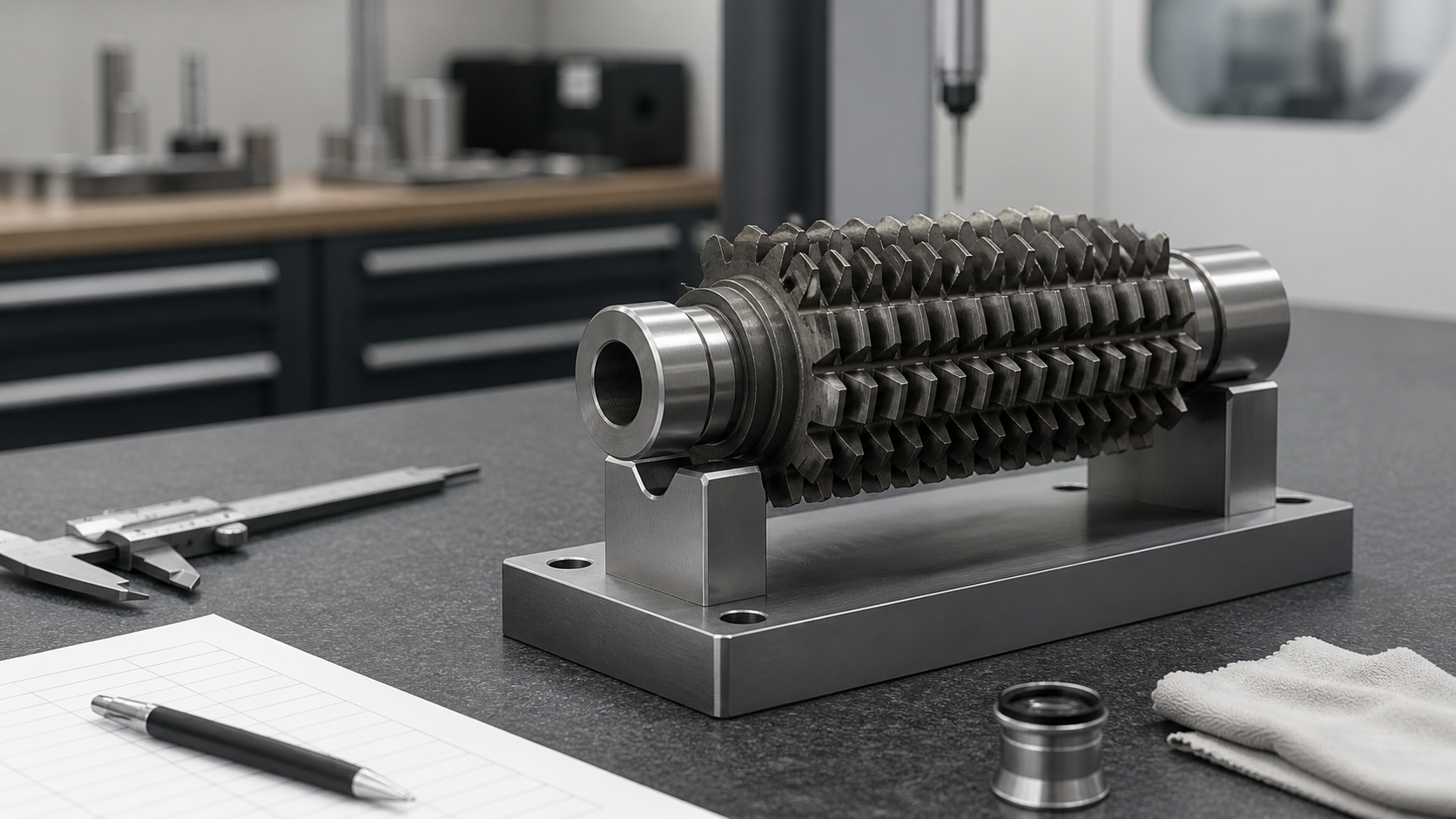
Gear Hob Regrind Checklist: Prepare a Clear Service Review
When a gear hob comes off the machine, it is tempting to send it out with only a note saying “regrind.” That leaves important context unstated. Before arranging a service review, identify the returned tool, capture what happened in its last operation and separate a returned-hob service request from any new-tool requirement.
Nobeve’s catalogue documents a complete hob regrinding and re-coating service flow: receiving, cleaning, checking and registration, wear evaluation, coating removal, regrinding, precision detection, re-coating, coating inspection, packaging and delivery. This checklist helps a purchasing or manufacturing team prepare for that review. It is not a declaration that every returned hob is suitable for regrinding or re-coating.
The short answer: send identity, context and observations
The catalogue names the service stages, but it does not publish a mandatory customer intake form. Start with the information that lets the service team associate the returned hob with its application and understand the issue without guessing:
- Tool identification: the tool marking, drawing, purchase reference or other available identifier.
- Last application: the gear operation and the workpiece condition recorded when the hob was last used.
- Machine context: the hobbing machine, mounting or arbor condition, and cooling arrangement.
- Observations: the wear, damage, inspection concern or process change noticed before the tool was removed.
- Review objective: whether the immediate need is assessment, service-feasibility review, return-to-production planning or drawing clarification.
These are preparation points, not catalogue-defined acceptance criteria. Provide what is available and flag gaps clearly so they can be reviewed rather than filled with assumptions.
Use the documented service flow to frame the request
The catalogue sequence gives a useful way to distinguish the stages that follow receipt of a returned hob:
- Receiving, cleaning, checking and registration establish the incoming service record.
- Wear evaluation occurs before the listed coating-removal and regrinding stages.
- Coating removal and regrinding are followed by precision detection.
- Re-coating and coating inspection follow the precision-detection stage.
- Packaging and delivery close the documented flow.
Avoid treating this order as a lead-time estimate, a regrind allowance, a cycle-count limit or a promise about tool life. Those conditions depend on the actual returned hob and are not specified in the published flow.
Record the observed issue without diagnosing it prematurely
Write down what the production team actually observed: where the concern appeared, when it was noticed and whether anything changed in the operation or machine setup. Pair that observation with the machine condition and current bottleneck. For example, the priority might be to clarify a service scope, understand an inspection concern or plan the return of a tool to production.
This keeps the intake useful without presenting an unverified diagnosis as fact. For terminology on common visible wear patterns, see Analyzing Gear Hob Wear Patterns; any assessment of the returned hob still belongs in the service review.
Keep new-tool inquiries separate from returned-hob service
A returned-hob regrind request and a new-tool inquiry require different scopes. State which one you are making:
- For HSS hob sourcing, identify the request as HSS sourcing and provide its separate tool specification and purchasing requirements.
- For a carbide hob inquiry, provide the hobbing-machine, application and component details for the new-tool request.
- For a carbide power-skiving tool, prepare a separate cutter-and-process package inquiry, including its own machine, cooling and geometry context.
Separating these requests helps keep service review focused on the returned hob while allowing a new-tool application to be evaluated on its own information.
Next step: request a scoped review
Send the available tool identification, last-process context, machine condition and observed issue through the Nobeve contact page. Ask the team to confirm the appropriate review scope before assuming a regrind, re-coating route, coating choice, timing or result for the returned hob.